Wednesday, 6 September 2017

New laboratory to ensure clean water supply, boost fisheries in the Albertine Graben

A section of Mpanga River in Fort Portal town containing bottles and wastes dumped recently. photo by Alex Ashaba

THURSDAY AUGUST 31 2017
http://www.monitor.co.ug/News/National/New-laboratory-to-ensure-clean-water-supply--boost-fisheries/688334-4077208-8tmu9/index.html


In Summary
·         Schedule. Construction of the water testing laboratory will commence in October and it is expected to be completed in two years’ time, according to Mr Steven Ogwete, the national project coordinator.


By FELIX BASIIME & ALEX ASHABA

KABAROLE/KASESE. Residents of Fort Portal Municipality in Kabarole District have long complained about the quality of tap water supplied to them.

Ms Nyakato Rusoke, a resident of Kitumba, East Division in Fort Portal Municipality, says: “I collected water, not from River Mpanga, but from a tap in the morning and I thought I would use it to prepare breakfast. What I saw defeated my understanding! Why should consumers part with our hard-earned money to pay for such dirty water”.

She continues: “In my layman’s view, this water is not fit to even be used in a toilet, because it will leave it stained! I have observed this for some time.”

However, with the establishment of a multi-billion laboratory for testing water quality in the Albertine region in the offing, things are set to improve.
The $7.321 million (Shs26. 2b) laboratory will be based in Fort Portal, Kabarole District.

The scheme which will commence in October, will be implemented under the lakes Edward and Albert Integrated Fisheries and Water Resources Management Project ( LEAF II), and is expected to be completed in two years’ time, according to Mr Steven Ogwete, the national project coordinator.

Mr Denis Muramuzi, the National Water and Sewerage Corporation (NWSC) Fort Portal branch manager, says it is expensive to filter polluted water from Mpanga River because it needs a lot of chemicals to purify it.

Because of the contamination in the last six years, water treatment cost at NWSC plant in Fort Portal has tripled as they use more chemicals than before to purify the water.

NWSC supplies water to 7, 017 households in Fort Portal Town alone and of late consumers have complained of the quality of the tap water pumped to their homes.

“Therefore, the water testing lab by LEAF II will come with advanced data equipment that we shall all use to have better quality water. Currently, we do some quality tests at our plant in Fort Portal, but at times we take samples to NWSC lab in Mbarara,” Mr Muramuzi adds.

The Fort Portal laboratory is part of the bigger $24.54 million (Shs88. 3b) five-year project that covers Uganda and the Democratic Republic of Congo that will be complete in June 2021. The project is funded by Africa Development Bank and Global Environmental Fund (GEF).

The LEAF project will set up water resource monitoring and assessment centre for lakes George and Albert and their catchment areas.

The project is aimed at boosting fishing industries of countries that share the lakes.
Rivers Nyamwamba, Mpanga and Semliki empty into lakes George and Albert, respectively. Human activities along these rivers affect the water quality upstream to downstream and also affect fishing in the lakes through siltation and pollution.

“LEAF is to sustainably increase the lakes’ fish productivity by promoting good fish capture and management practice, restoration of the lakes catchments and improvement of water quality on the shared lakes’ water resources” said Mr Ogwete.

According to Mr Ogwete, the project will also provide a platform for local governments to share and exchange knowledge, information, experiences, lessons and challenges that may be faced in managing and conserving water bodies.

In the Albert region, LEAF II Project covers Bushenyi, Rubirizi, Mitooma, Kanungu, Kasese Rukungiri, Bundibugyo, Ntoroko, Hoima, Kagadi, Buliisa, Kibaale, Masindi, Nebbi and Kabarole districts.

Mr Ogwete says the project will create an enabling environment and strengthen the legal, policy, institutional and regulatory framework for sustainable management of natural resources and protection of the environment.

The project has three components: fisheries development and management, integrated water resources management and project management and coordination.
Under the fisheries development and management, landing sites with fish processing facilities, feeder roads, and safe water supply and sanitation facilities will be constructed.

Five landing sites will be constructed at Rwenshama on Lake Edward, Mahyoro on Lake George, and Kitebere, Mbegu and Bei on Lake Albert.
Goals
LEAF phase II is expected to tackle poverty reduction, ensure food security through development of fishery sector where nearly 45, 000 jobs are expected to be directly and indirectly created.

About 50 per cent of those expected to benefit from the fisheries sector are women.
“Due to the weakened river banks arising from human and cattle paths, erosion along the banks has contributed to the release of soils into the rivers leading to the silting effect of the river on the DRC side,” Ogwete says

“There is a need to dredge and deepen the River Semliki and remove the silt that has blocked the passage of water along the channel causing its continuous shift,” he adds.

·          

Monday, 14 August 2017

New tarmac road boosting business in western Uganda

A truck ferrying traders on Fort Portal-Kamwenge road recently inside Kibale national park. PHOTO BY FELIX BASIIME.  


THURSDAY AUGUST 10 2017


In Summary
·         Easy. Traders now find it easier to access market for their goods due to the smooth road.


By Monitor reporters

FORTPORTAL/KAMWENGE. The completion of the 206km Fort Portal-Nyakahita Road is boosting business and tourism in western Uganda.
The last section of the road, the 66 km Kamwenge-Fort Portal stretch, was completed recently.

New businesses, including eateries, lodging facilities among others, are springing up along the new road.

Before the completion of the Ibanda-Fort Portal road, there were only two minibuses plying the Fort Portal-Mbarara route. There are now 13 minibuses plying the route.

Also, in the past, many travellers would connect to Mbarara District via Kasese District, which would make the journey longer by 50kms.

Many farmers, commuter minibus drivers, vendors and residents say they are optimistic business will boom and that they will reap the benefits associated with tarmac roads.

Ms Agnes Kobusige, a farmer from Bukwali, East Division, Fort Portal Municipality, said five years ago, transport was very difficult on the Fort Portal-Kamwenge Road.
She said the road had very many potholes and was always impassable in the rainy season as vehicles would get stuck on the muddy road for hours.

The traders would have to wait for the road surface to dry before they could resume the journey. This could sometimes take days, and in the process, some goods, especially fresh produce, would get spoilt.

Ms Kobusige said now that the road has been upgraded from murram to tarmac, farmers find it easy to transport their produce to the market.
“We are now able to access markets for our produce outside Rwenzori sub-region,” Kobusige said.

Mr Sunday Tadeo, 40, a taxi driver on the new Fort Portal-Kamwenge Road, said before the road was upgraded, they would not drive up to Mbarara Town because the road was so bumpy.

He said it now takes them one-and-a-half hours to drive from Fort Portal Town to Kamwenge District, unlike in the past when the same journey would cost them at least three hours.

“We are now earning more profits because we make [more] return journeys, which was not the case in the past,” he said.
He added that the cost of repairing their cars has also reduced since they now rarely breakdown.

Passengers are also benefitting from the upgrade of the road since taxi fares, for instance from Fort Portal to Kamwenge District, have reduced from Shs15, 000 to Shs10, 000.

Mr Robert Mugabe, a trader at Kabudaire Market in Fort Portal Municipality, said his business of buying produce from Kamwenge has been boosted by the new road as farmers can easily deliver the goods to him.
According to the records at Kibale Forest National Park, many tourists now find it easier to access the park through Nyakahita-Ibanda-Kamwenge-Fort Portal road.

The Kamwenge District chairman, Mr Aggrey Natuhamya, said the upgraded road has boosted business and tourism in the area.

“We are now receiving more guests at Katonga Game Reserve, Lake George, rivers Mpanga and Dura, Kanyancu Tourist Centre and Bigodi wetlands sanctuary,” he said.
He added that the new road has also boosted business for lodging facilities such as Mantana, Nkingo and Bigodi Resort, all in Busiriba Sub-county, Kamwenge Guest home, Tides Motel, Club Afreka and Cape hotel in Kamwenge Town Council.

The Ibanda District chairman, Mr Melichiadis Kazwengye, said the new road will increase the pace of development in the district.
“Now many traders from Kiruhura and Kamwenge districts make stopovers in Ibanda, thereby boosting business here as well,” he said.

Reported by Felix Basiime, Alex Ashaba & Fedinand Tuhame.

Stigma affecting HIV/Aids fight in Kasese, Kabarole


A health worker conducts an HIV/Aids test on a child. File photo 


THURSDAY AUGUST 10 2017


In Summary
·         Stigma. Many people living with the virus fear to disclose their status due to fear of discrimination.


 By FELIX BASIIME

Kasese. Sarah (not real names), 13, stays with her mother, Margaret Birungi at Nyakasanga West in Kasese Municipality, Kasese District. Both daughter and mother are living with HIV/Aids. Sarah’s father died five years ago.

As a single mother of five, Birungi could not afford staying in town with the family and decided to send Sarah and her siblings to her grandparents in Kibiito, Kabarole District in 2015.

In Kibiito, Sarah joined Mugoma B Primary School, where she dropped out in Primary Three due to stigmatisation.

“She had to leave school due to stigmatisation from her peers and teachers. Pupils would laugh at her for taking ARVs, while teachers would beat her for not performing well in class as she would most of the time miss classes due to sickness,” her mother recollects. She adds that her family was forced to relocate to their current residence in Kasese, where she believed the stigmatisation would be less and also live in better social and economic conditions.

Birungi says even when she [Sarah] fetched water at the borehole in the village, other people would not use it, claiming they would contract the disease.

“I asked myself why I was the only one taking drugs daily and my other siblings didn’t,” Sarah narrated her ordeal to Daily Monitor in an interview recently.

Though the family relocated to Kasese Town, Sarah hasn’t resumed school as she and her mother spend most of the time attending clinics at St Paul’s Health Centre IV.
Birungi says: “Yes, we are now in town, there is less stigmatisation, and better feeding but I cannot afford school fees for Sarah.”

However, despite the interventions by government and other stakeholders, including NGOs, stigmatisation is still a big hurdle in the fight against HIV/Aids.
According to Faith Makombi Kwebaze, the programmes coordinator at National Community of Women Living with HIV/Aids (Nacwola), an NGO based in Kasese, out of 6,800 children in their area of coverage, only 3,500 can disclose their sero status.

Nacwola covers Kasese, Rubirizi, Kiruhura and Sheema districts.
“Stigmatisation and discrimination is still there, especially among the married couples. This is because most men have limited information about HIV/Aids prevention,” Makombi explains.

“Women test for HIV/Aids but when they go back home and disclose their positive status to their husbands and other family members, they are discriminated against and the family breaks up,” Makombi adds.

Nachwola community volunteers (individuals living with HIV/Aids) have come up to offer free counselling services to people living with HIV/Aids as one of the ways to fight stigmatisation.

“We have community volunteers and in schools, our monitors go there to teach life skills to pupils,” she adds.

At St Paul’s Health Centre IV, where both Sarah and her mother Birungi attend weekly clinics, Annet Bintu, a psychological councillor, says they have tried to reduce stigmatisation through counselling.

“We have 59 children who attend our clinics and we have fought stigmatisation up to 65 per cent, which means out of 100 people, 65 can disclose their zero status,” Bintu says.
According to John Thawite, the Kasese District HIV/Aids coordinator, stigmatisation is one of the biggest challenges they are facing in the fight against HIV/Aids.
“Some people have failed to disclose their status because of stigma from the public,” he says.

As a mitigation measure, he says the district authorities have embarked on counselling, especially to the young ones and married couples.

“We have also set up sub-county HIV/Aids committees where we train members to support others. We further encourage teachers to talk about HIV/Aids in classes,” he says.

He adds that as a district, they are about to release a five-year HIV/Aids plan with more interventions, including carrying out a stigmatisation and discrimination survey in the district.

“This survey on stigma and discrimination will give us a direction on more strategies,” he adds.

Wednesday, 2 August 2017

Kabarole leaders clash over city status


Development. A section of Fort Portal Town. A dispute has ensued between those in favour and against the proposal to change the name of the planned Fort Portal city to Kabarole city. PHOTO BY FELIX BASIIME 

THURSDAY JULY 27 2017
http://www.monitor.co.ug/News/National/Kabarole-leaders-clash-over-city-status/688334-4033602-prg13jz/index.html

In Summary
·         Complaint. Kabarole District local government leaders argue that Fort Portal is a foreign name imposed on them by the British colonialists, adding that the proposed city should be given a local name, Kabarole.

By MONITOR TEAM
Kabarole.
A dispute has erupted between Fort Portal Municipality leaders and their Kabarole District local government counterparts over a proposal to change the name of the planned Fort Portal city to Kabarole city.
The row was sparked off when Mr Richard Rwabuhinga, the Kabarole District chairman, during a council meeting last week moved a motion to amend the earlier resolution passed by the same council to change the name of the proposed “Fort Portal tourism city’ to ‘Kabarole tourism city”.
The Kabarole District local government leaders argued that Fort Portal is a foreign name imposed on them by the British colonialists, adding that the proposed city should be given a local name, Kabarole which they said residents have a huge cultural attachment to.
They expressed fear that if the proposed city is name Fort Portal, the name Kabarole will cease to exist because the city area is expected to cover Fort Portal Municipality and Burahya County which constitute Kabarole District.
The Kabarole District local government leaders said the name Kabarole is of cultural significance to the native Batooro and synonymous with the Tooro kingdom, citing the location of King Oyo Nyimba’s palace on Kabarole hill that overlooks Fort Portal Town.
Fort Portal Municipality MP Alex Ruhunda said: “Kabarole District is the headquarters of the entire region and the name should be Kabarole, Fort Portal tourism city should stop confusion”.
However, Fort Portal Town mayor Rev Kintu Willy Muhanga said the municipal council is autonomous from Kabarole District local government, according to the Local Government Act.
“For example, Kabarole District Local Government has a chief administrative officer who is appointed by the central government and the municipal has a town clerk who is also appointed by the central government,” Rev Muhanga said.
“We are not answerable to the district though we are under Kabarole District,” he added.
He vowed to sue Kabarole District local government for its bid to change the name of the proposed city without the consent of the Fort Portal Municipal authority.
“The proposal to change Fort Portal Municipality to Fort Portal tourism city was passed (in 2014) after several consultations with stakeholders, including division councils, but this time, the district council left us behind, why?” Rev Muhanga wondered.
Mr Nyamungo Francis, the Fort Portal Municipality deputy town clerk, said: “As an urban authority, we are still pushing towards national vision of 2040 for Fort Portal tourism city, not Kabarole tourism city”.
He added that Kabarole District local government leaders were illegally trying to change the name of the proposed city.
Both Fort Portal Municipality and Kabarole District local government in 2014 passed a resolution to allow Fort Portal Municipality become a tourism city.
Mr Joram Bintamanya, the Fort Portal Division councillor, said: “According to the proposal, both names would be maintained and people should not worry about it at all.”
He added: “Should Fort Portal town be elevated to a city status, it will be Kabarole city and Fort Portal will become one of the city divisions of Kabarole city.”
Kabarole District used to cover the whole of Rwenzori sub-region until the late president Idi Amin carved Kasese (for Bakonjo) and Bundibugyo (for Bamba/Babwisi) out of Kabarole in a bid to resolve the then tribal conflicts.
Later, the size of Kabarole kept shrinking after Kyenjojo, Kamwenge, Kyegegwa and Bunyangabu districts were carved out of it during the NRM regime.
However, some analysts say the main reason behind the move by Kabarole District local government to hurriedly change the name of the proposed Fort Portal tourism city to Kabarole tourism city is the fear to lose jurisdiction, status, civil and political structures when Fort Portal town becomes Fort Portal tourism city.
According to the Local Government Act, the city can only be created when it has a population of 350,000 people living in the same area.
Mr Muhanga, the Fort Portal Town mayor, said currently Fort Portal has only 70,000 people.
He added that the proposal to annex some sub-counties of Bunyangabu district to Fort Portal should be effected to enable the population reach 350,000.
The Bishop of Rwenzori Diocese, Rt Rev Reuben Kisembo Amooti, cautioned the leaders against arguing about the name of the proposed city, calling upon them to instead focus on delivering quality social services to the people.
By Felix Basiime, Alex Ashaba & Scovia Atuhaire

Thursday, 22 June 2017

How tree planting drive restored salt production in Kasese District


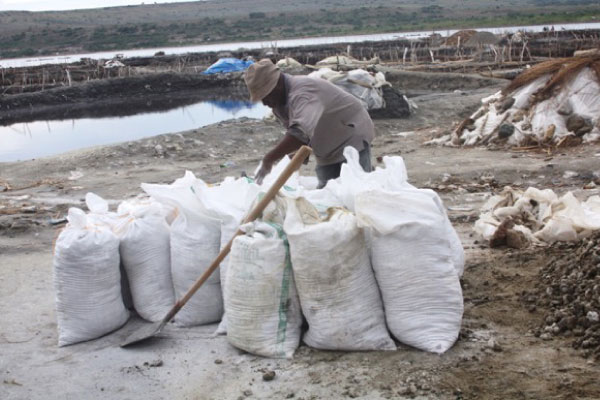
A man packs salt in sacks at Lake Katwe in Kasese District recently. Following a tree planting campaign launched in 2012, at the shores of Lake Katwe, salt miners are now able to collect salt in large volumes. PHOTOS BY FELIX BASIIME


THURSDAY JUNE 22 2017

By FELIX BASIIME
KASESE- Ms Sanyu Madina, 27, is a salt miner at Lake Katwe in Kasese District. She has conducted this business for the last eight years and operates seven salt pans.
Salt pans are man-made features on the lake shores where salt forms naturally and according to Ms Madina, Lake Katwe has more than 1000 salt pans.
When Daily Monitor visited her at one of the salt pans, Ms Madina revealed that for the eight years, she has never experienced such huge volumes of salt being harvested currently.
“Since I was born, I have never seen such volume of salt produced here because there is no more flooding at the lake,” she says, adding, “Floods would submerge our salt pans and block us from mining the salt”.

The slopes over the years were laid open by salt miners who cut the trees to create the salt pans on the lake shores, leading to soil erosion that caused siltation and flooding of the lake hence low production of the salt in the lake for the last seven years.
She attributes the new changes to the restoration of the slopes around the lake after salt miners embarked on tree planting campaign since 2012, an initiative of National Association of Professional Environmentalists (NAPE), an environmental advocacy body.
Lake Katwe is a crater lake situated inside Queen Elizabeth National Park.
Mr Arinaitwe Kagongo, the NAPE guide at the lake, says business was slow since May 2010, after the lake flooded as a result of climate change threatening lives of more than 8,000 residents who depend on salt extraction for a living. 

“The flooding left more than 3,000 porters jobless and the urban authority lost Shs24m in revenue each year. Floods also forced residents to seek alternative jobs while a few resorted to extracting the muddy salty commonly known as Kifuufu, a poor quality that is at times sold to cattle keepers,” Mr Kagongo says.

Since then, the number of people working and owning small wells (salt plots) on the shallow lake kept dwindling due to slow business. Since May 2010, one could hardly find more than 20 people on the lake working.
A salt miner at peak season would earn between Shs20,000 to Shs 40,000 daily before the flooding of the lake. Mr Kagongo says the floods that hit the area between 2010, and 2011, dissolved the salt in more than 8,000 salt pans.
He attributed this to the environmental factors that Lake Katwe faced where the vegetation cover on the banks were degraded.
“Long ago, this crater salty lake was surrounded by a forest, but it is gone, so rain water just floods in the lake and therefore, salt rocks can’t form under such conditions, but we have rejuvenated it and now production has resumed in high gear,” he says.

According to Ms Madina, currently a sack of about 100kgs of rock salt goes for Shs15, 000 compared to the previous years when the lake would flood and there was nothing to extract.
“During the period of floods at the lake, a sack of 100kgs would sell between Shs 20,000 and Shs 30,000 because there was low production” she recalls.
In January 2012, salt extraction resumed at the salty Lake Katwe in Katwe-Kabatooro Town Council in Kasese District after a dormant one and half years due to flooding.
“The trees we planted have helped to reduce the erosion and flooding,” Ms Madina says.
Business usually booms during the dry seasons, (from January to March and June-September) when the water in the shallow lake evaporates, exposing the salty rocks underneath. 

The salty lakes in Kasese District used to be Katwe, Nyamunuka, Bunyampaka and Munyanyange but today, only Katwe and Bunyampaka have salt.
Traders around East and Central Africa have for many years flocked Lake Katwe to load about eight to 10 lorries of salt daily. 

The lake produces three types of salt; Crude salt for animal leak, edible salt (sodium chloride) and unwashed salt.
Revenue
According to the Town Clerk of Katwe-Kabatooro, Mr Godwin Bihanikire, in the last financial year, the urban authority received Shs438m in revenue as loading fees at the lake but in the new budget, they have projected Shs458m.
Mr Kagongo says Lake Katwe would have become barren like other salt lakes in the district if there were no interventions by NAPE and the salt miners to rejuvenate it.
“The problem is that we used to cut the grass and trees from the slopes around the lake and on the lake banks to create our salt wells, which caused the rain water runoff, but this stopped and we started using sand in sacks,” says Ms Halima Nasanga, a worker at the lake.

Mr Jeconious Musingwiire, the western region public awareness officer for NEMA, says: “There is need to properly manage the water catchment areas around Lake Katwe.”
Lake Katwe remains the main source of income among the inhabitants of Katwe-Kabatoro Town Council in Busongora South. People still practice rudimentary mining of salt to earn a living.
As a solution to the current high production, Kagongo said they are trying to boost local market.
“As miners, we are trying to boost the local market of the salt through sensitising the public that Katwe salt is safe for both human and animal consumption,” he adds. 

Wednesday, 21 June 2017

How goats are keeping girls in school in Kabarole

Ms Annet Mbabazi. Photo by Felix Basiime 
SUNDAY MAY 7 2017

By Felix Basiime

http://www.monitor.co.ug/Magazines/Full-Woman/How-goats-are-keeping-girls-in-school/689842-3916520-2rvjf3/index.html

KABAROLE:
To safeguard against parents being tempted to pull their girls out of school to marry them off for goats, parents are given goats but on condition that they keep their daughters in school.
Naome Aisha, 12, walks over three kilometres daily from home to study in Primary Five at Mahyoro SDA Primary School in Mahyoro village, Karangura Sub County in Kabarole District.
Her parents, Nathan Mutera and Jackeline Biira, are peasants and at times fail to raise school fees and money for other scholastic materials.
Aisha is not alone facing this challenge. Annette Mbabazi, 14, also walks over three kilometres to study in Primary Seven at Kibyo Primary School in Kibyo village, also in Karangura. Her parents, Peter Rwabutuku and Topista Kirinda, are peasants too who grow beans and sell them to raise part of her school dues.
Both Aisha and Mbabazi grew up in a rural set up where early marriage is the order of the day due to the traditions and myths among the people in this hilly area. Here, a girl hardly studies beyond Primary Five. If she is not married off by her parents for quick money, she runs a risk of boys waylay her on the way back from school in the evenings and raping her, and the next day parents of both parties meet to settle the dowry, which is between Shs 500,000 to Shs1m.
Goats to the rescue
However, Aisha, Mbabazi and some other needy girls in this district have managed to remain in school and stay focused on education despite the odds stacked against them in the rural set up that include a cob web of cultural beliefs and myths about young girls.
A goat project undertaken by Joy For Children (JFCU), an NGO operating in the Rwenzori sub region, has kept the girls at school.
JFCU gave 33 and 29 goats to girls at Kibyo SDA and Mahyoro Primary Schools respectively. Aisha and Mbabazi are among the beneficiaries of the goat project. Since 2005, Joy For Children-Uganda has been advocating for and supporting the rights and needs of vulnerable children in Uganda.
Along with a team of local and international volunteers, the NGO and its partners among others work to prevent all forms of violence against children, including child labour, ensure access to high-quality education for all children, and end the exploitation of girls and the practice of child marriage.
The goat project code named; Girls Empower Project “Is piloted in Karangura Sub County, Kabarole district in two schools; Mashyoro and Kibyo primary schools,” says Jennifer Kahumuza, the area coordinator (Kabarole) Joy for Children Uganda.
“I received the goat in 2015. This goat is my security to stay at school. I make sure that before I go to school, I first take it to feed it and in the evening I come back rushing to untether it. If my parents ever fail to raise fees, I will sell its produce and remain in school,” says Aisha.
“I also got a goat in 2015. It has now delivered twice, I have to safeguard my goats so that they help me stay in school until higher education,” says Mbabazi.
“It is very difficult to nurture and teach girls in this area; they are enticed with small money to drop out of school by boys because of poverty,” says Joy Muke, the Senior Woman at Kibyo Primary School.
She says the challenges of a girlchild in these hilly hard-to -reach area include walking long distances to school and the girls “meet many evils on the way.”
At school, she says when a girl gets her monthly period, she is sent back home and misses classes. “There is poverty, no sanitary pads and parents cannot afford them. There are also no private washrooms at school where girls can help themselves,” says Muke. “Without enough support and counselling for these girls by parents and teachers, child marriages will remain high in Uganda.”
The cultural inhibitions
The rolling Karangura area is predominantly inhabited by Bakonjo whose most traditional rural set up parents marry off young girls. “The social, cultural traditions of Bakonjo consider marriage prestigious. The target for the parents is to get goats (as dowry) from the marriage unions and this has affected the girls’ chances to continue with education,” Muke observes.
She says that Joy For Children has invested in sensitising the parents in the area about marrying off their young girls and has shown them the benefits of education.
“The parents have now started knowing the value of education more than before, there is definitely great improvement of recent,” Muke says.
According to UNESCO, Uganda has a very low primary survival rate of 33 per cent, this means that only one third of children starting together in Primary One still being together when completing the primary cycle in Primary Seven.
The primary survival rate in neighbouring Tanzania is 78 per cent. Major causes of school dropouts in Uganda are early marriages and teenage pregnancies according to Out of School Children Study in Uganda, 2014.
The Girls Empower project is aimed at reducing the high rate of school dropout by preventing early pregnancies and child marriages.
“Child marriage in Uganda is a result of many things. Mainly, it is a result of poverty as well as limited access to education for girls,” Kahumuza says, adding, “Furthermore, strong traditional and social norms exist, which dictate that girls are married at a young age in order to fulfil their role as a wife and mother.”
A survey carried out by the organisation in the mountainous sub counties of Kabarole District of Karangura, Kabonero, and Kateebwa inhabited mainly by Bakonjo in July –October 2013; found out that child marriage is the leading cause of girls dropping out of school.
At Nyarukamba Primary school in Karangura, the school dropout rate of girls for marriage was at 15 per cent in 2009 and 10 per cent in 2012. The young girls are married off in exchange for goats, ranging from one to five.
The same survey tells a story of a 14-year-old who did not sit for her Primary Leaving Examination 2013 at Nyarukamba Primary school.
Her parents negotiated for her marriage without her consent in exchange for two goats in a nearby community. The headteacher reported the case to police but the parents insisted that their daughter went to visit her relatives in another district.
Finding solutions.
The Girls Empower project have designed several strategies to combact these challenges including raising awareness, and education and empowerment through school outreaches to monitor formation and strengthening of child-rights clubs.
They are also training local leaders to participate in advocacy, giving out goats after signing a Memorandum of Understanding by parents committing to keep their girls in school, procurement and supply of scholastic materials, radio programs, training in life skills and making re-usable sanitary towels.
The project has so far reached 100 families targeting mainly vulnerable girls.
Mukewants government to set up more schools in Kabarole District, especially in the hilly areas such as Karangura so as to reduce on the distance walked by girl children from home to school. “Let government provide each school with a washroom and the NGOs provide basins and sanitary pads to girl pupils,” Muke says.
He adds, “Government should also hire more female teachers at all schools in the country. You find at some instances a male teacher acting as ‘Senior Man’ to handle girlchild issues at schools because some schools don’t have female teachers.”
“Government and NGOs should give teachers in such hard-to-reach areas more essentials because we face a lot of challenges, you find I use my own resources to sensitise girls and parents,” Muke observes.
She adds, “About three years ago, girl- children were not going beyond Primary Five but now most reach Primary Seven.”
What is government doing?
Asked what programmes Kabarole District has put in place to avert early child marriages or to see children continue with education, the district vice chairman, Moses Ikagobya explains, “We lobbied Save the Children to help children, especially those out of school, by availing training in vocational skills.
“We also do sensitisation in collaboration with the schools administration through music, dance and drama”.
In October 2016, State Minister for Primary Health Care, Joyce Moriku, while commemorating Safe Motherhood Day for Bundibugyo and Ntoroko Districts in Ntoroko District cautioned girls against engaging in sexual relations when they are still young as it endangers their lives and distorts their future.
She further said; “As government struggles to enhance health services in the country in fighting maternal mortality rates, parents also need to play their responsibility of warning children about the dangers of early marriages and early pregnancies. Most pregnant mothers who get complications during delivery are young girls, therefore, to reduce this problem of high maternal mortality rates, parents also have a crucial role to play,” she said.
The statistics
According to a research on the situation of Uganda’s children carried out in Western Uganda in 2015 by Jostas Mwebembezi, an IT expert at Ride Africa, there is a gap in providing sex education.
“Our children might be at risk of engaging in sexual relations early, we have a lot of trouble trying to educate our children about sex education. We think we will tell our children to abstain, but they may not. There is a gap in providing sex education by the different people-by the parents, religious leaders or other people in the community” the research released on February 4, 2016, says.
The research was carried out in the Western districts of Bundibugyo, Hoima, Kabarole, Ntoroko, Kyegegwa, Kamwenge, Kasese, Kibaale, Kyenjojo, Masindi, and Buliisa.
According to the research, one in every four adolescents in Western region has had a teenage pregnancy while girls with even just primary level education are two times less likely to have had sex, while girls with secondary education are three times less likely.
According to the National Census report released by UBOS in 2016, in Kabarole District 82.4 per cent of children aged six to 12 years attend primary school. But the same report indicates that 82.4 per cent aged 15 years and older are not in school, having gone up to Senior Four as their highest level of education. The 2015 National service delivery survey, also conducted by UBOS, found that 72 per cent of primary schools in Tooro region provide lunch to pupils. Also, over eight in every 10 day pupils in Tooro travelled three kilometres or less to school.


Monday, 5 June 2017

Agony as Ntoroko loses 15,000 cattle to drought


Joint efforts. Herders assist a cow to stand in Rwebisengo Sub-county , Ntoroko District. Currently many animals are weak, while others are dying of starvation. PHOTO BY SCOVIA ATUHAIRE. 

THURSDAY MAY 11 2017

In Summary

·         Plight. According to the district veterinary officer, many cows have died due to starvation caused by lack of pasture and water.


By SCOVIA ATUHAIRE & FELIX BASIIME

Ntoroko. Herders in Ntoroko Distict have been left in agony as they count losses following the death of more than 15,000 cattle due to prolonged drought, district veterinary officials have revealed. 

Not only has the situation led to a drastic drop in prices of cattle, it has also put the lives of residents at risk as they have nothing left to depend on.

The small town that sits on the southern shores of Lake Albert has since July last year experienced constant floods and drought that have destroyed crops, pastures and swept away houses and roads.

According to the district veterinary officer, Dr Patrick Bagonza, this has painted a gloomy picture among the Tuku community.

“Many cows have died because of starvation due to lack of pastures and water. Some farmers had constructed dams but they all dried up,” Dr Bagonza said.
The areas most hit by drought are Budiba, Kibuuku, Kanaara, Bweramure, Butungama and parts of Rwebisengo Town Council among others.

Although some areas neighbour Semuliki National Park, herders have been denied access to the pastures in the park which has left their animals gaunt and feeble.

According to Dr Bagonza, the animals need to be supported in order to move since they cannot ably stand on their own.
Currently diseases like trypanosomiasis and ticks are on the rise due to the low immunity among cattle.

According to the district information officer, Mr Ibrahim Baluku, transacting businesses in Ntoroko has proved perilous as the area is hit by floods and drought back-to-back each year.

However, whenever the area is hit by catastrophes, the government only responds through donation of relief items like posho, beans, jerrycans and tents which residents say cannot sustain them for a long period.
Contaminated water
Residents in Rwebisengo Sub-county, which is the most drought hit, have no option left but to compete for the dirty salty pond water with their animals, which exposes them to higher risks of acquiring water borne diseases.

Although no human deaths have so far been reported, there are fears that if the situation is not arrested, it will get out of hand.

“If cattle keepers are taught how to make hay and silage for the future, I think this can solve the issue of shortage pasture during the rainy season. Hay and silage can be kept for long and used in future,” Dr Bagonza reasoned.

The Rwebisengo Sub-county chairperson, Mr Christopher Mujungu, observes that the drought has also affected the local revenue.

“The sub-county has been getting about 80 per cent of its local revenue from cattle. Government work is now at a standstill because we are depending on central government releases that cannot enable us push on with our community work,” Mr Mujungu said.

He added that in the last quarter, the sub-county received about Shs20 million in local revenue from cattle markets but this has since dropped to Shs12m this quarter.

The chairman Rwebisengo Cattle Keepers Association, Mr Charles Mujungu Kasoro, predicts harder times ahead.
Pledges
During the 2016 campaigns, President Museveni promised to extend water to the area to benefit people as well as feed their starving animals but the residents are waiting for the President to fulfill his pledge.

“President Museveni pledged to avail us safe water but we have never seen anything and yet we lose our cows to starvation every year,” Mr Kasoro noted.

According to Mr Kasoro, prices of cattle have gone so low because of the current situation. “We used to sell mature cows between Shs700,000 and Shs900,000 but now prices have gone down to as low as Shs50,000 to Shs70,000 for an emaciated cow and a dead one goes at Shs50,000 or just buried as we don’t get buyers,” he said.

Ntoroko District is inhabited by the Bakonjo and Batuku indigenous tribes as cultivators and cattle keepers respectively.
Batuku depend mostly on milk from their cattle because they don’t grow crops.
“Imagine living a culture of buying food, it means without money you cannot eat” he said.

Speaking to Daily Monitor, Mr Patrick Muhumuza , a meat dealer in Rwebisengo, noted that although prices have gone down, the demand for meat is also low as many cows are being slaughtered daily.

“Some months ago, I used to buy cows between Shs 200,000 and Shs 300,000 when sunshine was not much but now I buy them at Shs50,000 because many cows are dying. We slaughter them, dry the meat and sell it in markets depending on the size of dried meat; we sell between Shs 5, 000 and Shs12,000 per kg,” he said
Lobbying for support
However, the area Member of Parliament, Mr Gerald Rwemulikya, said he has already engaged the Prime Minister for relief and other interventions. 

Mr Rwemulikya said he received five tonnes of maize for planting in March. “I kept it because our people may eat the seeds because of drought and it is treated and poisonous”

According to the district chairman, Mr Timothy Kyamanywa, the drought and floods have always stretched the district budget and resources by increasing the cost of containing malaria, especially among the children.
Voices
“I have lost 82 heads of cattle since December 2016. These cows are my everything because they are my source of income. My children trek 5km looking for safe water for drinking,” Alexander Mujwara, cattle keeper
“Since the dry spell in December, 2016 I have nothing to prepare for my children because food prices have gone high and I have no money. We sometimes spend a day hungry because of lack of money,” Ester Kabarwani, resident